Digitalisation, networked systems and automation are rendering modern electrical installations increasingly complex. The rising proportion of renewable energy sources in the grid is changing its parameters in terms of short-circuit behaviour and protection technology, creating fresh challenges for planners and installers. With the new DEHNventil ACI M TNS 264 FM, DEHN is the first supplier to launch an arrester for Type 1 applications based on its ACI (Advanced Circuit Interruption) technology. The specialist for lightning and surge protection and safety equipment is thus expanding its established ACI portfolio for Type 2 arresters to create a comprehensive product family which fulfils the increasingly stringent requirements on surge protection in the field of electrical installation and planning.
DEHNventil ACI closes the gap: Advanced Circuit Interruption now extended to the area of Type 1 arresters
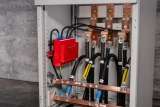
Conventional overcurrent protection such as fuses or circuit breakers is only to a limited extent suitable for protecting surge protective devices (SPDs), as required by IEC 60364-5-53:2001/A2:2015, as they can trigger unintentionally when exposed to lightning or impulse currents. The maximum backup fuse specified for the SPD does not reliably protect against residual currents in the range of several tens or hundreds of amperes, which can lead to thermal overload. By introducing the innovative ACI technology here, DEHN is pursuing a completely new approach. The classic overcurrent protection concept is replaced by integrating a powerful switch/spark gap combination directly into the surge protective device. In addition to offering overcurrent protection, this provides galvanic isolation in normal conditions. So, there are no leakage currents and the resistance to mains frequency temporary overvoltage (TOV) is significantly increased. This technology offers numerous advantages for planners and installers, reducing the planning effort without compromising operational safety. Dimensioning errors, questions about selectivity and complex calculations are now a thing of the past.
Reliable protection on the feed-in side
Besides setting standards in the Type 2 and DC areas, ACI technology is also of central importance for protection on the feed-in side, especially for Type 1 lightning current arresters. This is where high short-circuit currents and complex network conditions come together. IEC 60364-5-53:2001/A2:2015 requires that surge protection be installed as close as possible to the feeding point of the system. In practice, this is often difficult because connection cables may not be longer than 0.5 metres in order to prevent inductive voltage drops.
The modular combined arrester (Type 1+2+3) DEHNventil ACI M TNS 264 FM facilitates implementation: The integrated ACI technology eliminates the need for arrester backup fuses. The device can be mounted directly on earthed DIN rails or earthing rails. A cross-sectional area of 16 mm² Cu is always sufficient, since, even in the event of a fault, the integral current is so low that the connection cable is not thermally overloaded.
The disconnection function allows the module to be replaced safely during operation, either from the side or from the front, using insulated tools.
Technical details can be found here.

Simon Thaler ⎟ Head of Corporate Communications
Daily and Business Press